|
|
Hindoo

|
|
 |
|
|
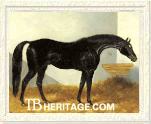
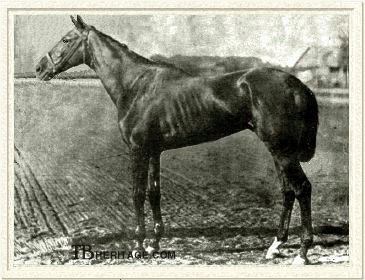
Hindoo, the most noted racehorse of his day, revitalized the Byerley Turk sire line in the U.S. for a few generations. In the decades immediately preceding and following the turn of the century, Hindoo, his sons, grandsons, and their sons and grandsons were preeminent racehorses of the American turf, accounting for nine American classic winners between 1884 and 1910, and for two leading sires during that period. He and his male descendants were also the most promising male line progenitors of imported Glencoe, forever known as the sire of the great broodmare Pocahontas in England, and of so many important American matrons. This once-promising sire line, however, petered after the good stakes winner Wise Counsellor (Laurel Stakes, International Special No. 1, etc.), a son of Mentor; Wise Counsellor was the leading sire of two year old winners in 1934, but was unable to get a good sire son.
Chart: Virgil's Classic Winning Descendants
Hindoo's sire, the dark bay Virgil (1864, by Vandal), a grandson of imported Glencoe, had been a decent runner, winning six races at distances up to two miles at age three, although generally he could not run beyond a mile, and was easily beaten by better horses. He was later trained to jump, and won races over timber "in good time." His jumping ability appears to have been more than a fluke -- Garry Owen, the grandson of Versailles (1866, by Vandal), was three-time winner of the ultimate timber race in the U.S., the grueling Maryland Hunt Cup, and Princeton, the son of Voltigeur (1872, by Vandal), also won that important steeplechase three times. Virgil himself had two Maryland Hunt cup winners, Bourgeois and Burgoright, descend from him via Burgomaster (1903), and an American Grand National winner, Penobscot, was a son of Yankee, a great-grandson of Virgil's. The tough little Abd El Kader, two-time winner of the Grand National at Aintree, was a male line descendant grandson of Sultan, Virgil's great-grandsire.
Bred by Robert A. Alexander at his famous Woodburn stud, where Lexington and imported Australian held court, Virgil was purchased as a yearling by Milton H. Sanford.
|
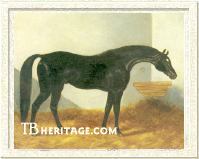
Hindoo's sire Virgil
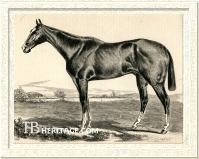
Vagrant was one of Virgil's small crop of 1873, who showed how undervalued his sire was.
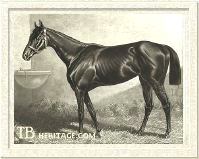
Firenzi (also spelled Firenze) was out of a full sister to Hindoo. She won 47 of her 82 starts, Champion filly at age 2, and Champion Handicap Mare at ages 4, 5 and 6.
| |
Sanford had built wool and cotton mills in Massachusetts prior to the Civil War, and made a fortune manufacturing blankets for the army during the war. Later a confederate of Maryland governor Oden Bowie, Sanford was among his guests at a dinner party where the notion of a stakes race for three year olds, with a huge purse, was developed. Sanford's horse, Preakness, won the lucrative $15,000 inaugural Dinner Party Stakes in 1870, the race which spurred Bowie's construction of the Pimlico race course. The Preakness Stakes, established at Pimlico in 1873, was named in Sanford's horse's honor.
Sanford sold Virgil to Daniel Swigert, then manager of Woodburn's "horse department," who raced him both on the flat and over fences, and then gave the horse back to Sanford, who sent him to his Preakness Stud in Kentucky, where Virgil was broken to harness and used as a buggy horse. When Sanford's principal stallion, Baywood, fell ill in 1872, rather than let the mares intended for him lose a season, Virgil was put to them. He was not liked by Sanford's manager, who considered him "delicate," somewhat supported by Virgil's failure to train on (on the flat) at the age of 4.
At the end of 1873, Virgil was given to Benjamin Bruce, the founder of The Thoroughbred Record, who could not sell him, nor attract mares to breed to him. However, in 1875, the youngsters from the 1872 breedings to Baywood's mares started running--Vagrant, Virginius, and Harry Hill. All three showed promise as two year olds, particularly Vagrant, who won five of his six starts at up to a mile, and was clearly the top juvenile of his year; at age 3 Vagrant went on to win the Phoenix Hotel Stakes by 40 yards, the Kentucky Derby, and the Grand Exposition Stakes at Philadelphia, in the latter beating Virginius, among others. As Virgil's small 1873 crop racked up win after win, the "give away" stallion whom Bruce couldn't sell for $300 just a few years earlier, was now valued at $2,000 by hopeful buyers, although all offers of purchase were refused. Bruce returned Virgil to Sanford, who later reportedly turned down an offer of $25,000 in gold for him. |
In 1876 Daniel Swigert, Virgil's owner when he raced, sent Florence, a mare by Lexington, to Virgil, from his nearby Stockwood Farm, which he had purchased in 1869. Her filly of 1877 was Florida, who became the dam of one of the greatest racemares of the American turf, Firenzi (1884, by Glenelg). Florence was returned to Virgil in 1877, and her colt, dropped in April of 1878, was Hindoo. Florence, born in 1869, and purchased from Woodburn, was a half-sister to Kentucky Derby winner Fonso.
A few years later, in 1881, Swigert purchased Sanford's Preakness Stud and re-named it Elmendorf, gaining with its purchase Virgil and the stallion Glenelg. The latter, under Swigert's ownership, topped the leading sires list four times in the 1880s. Virgil also headed the list, in 1885. In addition to Hindoo and his sister, Florida, Virgil got the following top horses for Swigert: Vanguard (1879, from La Henderson by Lexington), winner of the Preakness Stakes; Ben Ali (1883, from Ulrica by Lexington), winner of twelve races, including the Kentucky Derby, and Tremont (1884, from Ann Fief by Alarm), who was the undefeated champion two year old. The leggy, 16 hand tall Hindoo, however, was the best horse he ever bred, winner of 30 of his 35 starts, and American champion at ages 2 and 3.
Hindoo on the Track
Hindoo won seven of his nine races at age two, his two defeats suffered in races he ran after he had been brought home and turned out following his successive wins. Despite losing the Windsor Hotel Stakes, trailing third by a length, and in the next race coming second by a length to the good race filly, Thora, to whom he conceded eight pounds, he was considered the champion of his year. His wins included the Colt and Filly Stakes at Lexington, and the Alexander Stakes and Tennessee Stakes at Louisville, at distances of six, four and six furlongs each. Shipped to St. Louis, he won the Juvenile Stakes and the Jockey Club Stakes, the latter race a mile, which he won by six lengths. Sent to Chicago he won the six furlong Criterion Stakes, and then the Tremont Hotel Stakes over a mile.
At the end of his two year old season, he was purchased for $15,000 by the Dwyer brothers--Mike and Phil--who raced their horses hard; the more successful the horse, the harder it was tried. Hindoo, unlike other promising horses whom the Dwyers overraced, held up well under this regimen, winning eighteen races in succession, and losing the final two of his twenty races his three year old season. He was blessed with a calm temperament, "...a sweeter-tempered colt never sported silk," and great courage, never failing to respond to his Jockey's request. He typically ran from behind, or with the field, holding something in reserve for his jockey in almost all his three year old races, James McLaughlin, to call upon when needed. His trainer was James Rowe, who had also trained Luke Blackburn, the horse to which Hindoo was most often, and usually favorably, compared. Rowe, who later quit the Dwyers in protest over the great filly Miss Woodford's overracing, would go on to train the good racehorse and great sire, Commando.
Hindoo's third season wins included the 1-1/2 mile Blue Ribbon Stakes, the Kentucky Derby, the Clark Stakes, a purse stakes at Jerome Park, the Tidal Stakes, the Coney Island Derby, the Ocean Stakes -- meeting and beating older horses for the first time -- the Lorillard Stakes, and a walkover at Monmouth park. He went on to win the 1-3/4 mile Travers Stakes, then the Sequel Stakes by six lengths, followed by the United States Hotel Stakes, the 2 mile Kenner Stakes, the Champion Stakes, the Jersey St. Leger, and, finally, two match races against Sir Hugh in mile heats. The closest any of his rivals came to him during this amazing undefeated streak was a length behind, and most of his wins were much more decisive.
|
|
Hindoo's Race Record |
| Year |
Age |
Starts |
1st |
2nd |
3rd |
Unpl |
Earnings |
| 1880 |
2 |
9 |
7 |
1 |
1 |
0 |
$9,800 |
| 1881 |
3 |
20 |
18 |
1 |
1 |
0 |
49,100 |
| 1882 |
4 |
6 |
5 |
1 |
0 |
0 |
12,975 |
| Total |
-- |
35 |
30 |
3 |
2 |
0 |
$71,875 |
| |
In September of his three year old year, he ran second to Crickmore in the September Stakes, held six days after his second match race with Sir Hugh. Two weeks later he was beaten again by Crickmore -- whom he had bested several times earlier in the season -- in the Brighton Beach Purse, his last race of the season. That year he was the leading money winner running in the U.S., and again hailed as champion of his year.
|
At age four he won five of his six races, and placed second once, in his first race of the year at Louisville, when he was beaten by Checkmate. His wins included the Louisville Cup over 2-1/4 miles, the Merchant Stakes and the Turf Stakes, all three held at Louisville, and the Coney Island Stakes and the Coney Island Cup at Sheepshead Bay. After his last race, the 2-1/4 mile Coney Island Cup, his tendon sheath showed some swelling, and he was sold for the stud to Ezekial Clay and Catesby Woodford, who sent him to Runnymede Stud in Paris, Kentucky, where he remained until his death in 1901.
Hindoo in the Stud
At stud at Runnymede, where Sir Dixon and Ben Brush would later be foaled, Hindoo became a successful sire, near the top of the leading sires list in the late 1880s and in the 1890s, and placing second on that list when his first crop of 1884 were three year olds -- among them, JIM GORE, who won the Clark Handicap, like his sire. Also in that first crop was HANOVER, a terrific racehorse and even greater sire, who led the sire lists in the U.S. four times. Hanover was destined to carry on the Glencoe sire line, and his daughters' tail-female descendants included three Epsom Derby winners. A later Hindoo son, BUDDHIST (1886), won the Preakness Stakes.
|
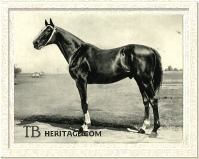
Hanover, 4 times leading sire, continued the Glencoe sire line.
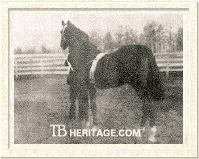
The game Jim Gore
| |
JIM GORE (1884, out of Katie by imp. Phaeton), bred at Kentucky's Coldstream Farm, was an incredibly game horse and good winner, but unlucky both in racing and at stud. At two he took three of his six starts: he won Latonia's Harold Stakes and ran second in the Sensation Stakes at the same meeting, giving away eight pounds to the winner. He also won St. Louis' Carriage Builders' Stakes (six furlongs, conceding weight), and Washington Park's Kenwood Stakes (5 furlongs), giving away weight to the field. At age three he was second to Montrose in the Kentucky Derby in his first start that season, pulling up lame after the race; despite being unsound he ran in the Clark Stakes (1-1/4 miles) eight days later, and won it easily. He was unsound throughout the remainder of his three-year-old season, but his owner ran him anyway, even though he was most often handicapped at top weight, eliciting great admiration in the sporting press for the horse's courage. He took Chicago's Boulevard Stakes (1-1/4 miles), and ran second to Libretto in the Latonia Derby (beating Montrose and other good ones), second to the good horse Terra Cotta in the St. Louis Derby, and again to that horse in Chicago's Drexel Stakes (beating Derby winner C.H. Todd).
JIM GORE retired to the Melbourne Stud at the end of his three-year-old season. He saw very few mares in his first several years; it wasn't until 1893 that he had more than ten foals, but he gradually built a reputation as a stallion. His winners included Moncreith (beat the great Ornament twice as a juvenile and once at age three), the juvenile champion Beau Gallant (beat Commando in the Matron Stakes, won Prospect Stakes), Beau Ideal (track record in the Gaston Hotel Stakes at Memphis), Boundless (American Derby winner), Donna Seay, a good juvenile winner of twelve races, and many other stakes winners. Many of his youngsters raced over forty times, often good juveniles, and hard-knocking handicappers. He was dam's sire of the great Exterminator.
|
Other good Hindoo sons included ALARD SCHECK (1898, from Cherry Blossom by Powhattan), a crack juvenile winner of nine races and $17,656, including the Hyde Park Stakes, the Kenwood Stakes, the Grand Union Hotel Stakes and the Westchester Highweight Handicap; DUNGARVAN (1888, out of Calphurnia by Julius), a winner of 51 races and $28,490; HINDOOCRAFT (1886, from Lady Crafton by Fellowcraft), a winner of 15 races, including the Latonia Derby, the Dearborn Handicap and the Owners Handicap at Morris Park; MACY (1894, out of Alga by Onondaga), who took 37 races, including the St. Louis Inaugural Stakes at age three; MERRY MONARCH (from Brambaletta by Bonnie Scotland), a winner of 22 races and $38,410; and many other stakes winners.
Hindoo's most influential daughter was the filly SALLIE MCCLELLAND (1888), from the Alarm mare Red and Blue. She won the five furlong Spinaway Stakes for two year old fillies in 1890, as well as the Eclipse Stakes and the Great Eastern Handicap, and at age 3 won the Alabama Stakes. In the stud, she produced Kentucky Oaks winner Audience (1901, by Sir Dixon), dam of Whisk Broom II and tail-female ancestress to the good stakeswinners The Nut, Today, and the champion two and three year old filly, Top Flight; Frances McClelland (1895, by Bermuda), ancestress of Crusader and many other good stakes winners; and Martha Gorman, Sallie of Navarre, and Saratoga Belle, the latter all good producers.
Other good Hindoo daughters included CATALPA (1884, from Calphurnia, by Julius), a winner of 24 races and $15,540, and her sister, MABLE GLENN (1887) a winner of 20 races and $20, 950. LILLIAN LINDSAY (1887, out of Delight, by Jack Malone) was a high class race mare and later produced Greenock, juvenile winner of the Brewers' Stakes and other good races. Her sister BRIGHTLIGHT (1889) was the dam of Jim Bright (1895), a winner of 13 races, including the Himyar Stakes. ALICE BRAND (1889, from Lady of the Lake by Hyder Ali), became the dam of Pink Coat (1895, by Leonatus), whose wins included the American Derby and St. Louis Derby at age three. Another daughter, ELOPEMENT (1890, from the War Dance mare Distraction) became the dam of Alcido (1897), a winner of the Jerome Handicap at three, and the Suburban Handicap at age four. MAID OF BALGOWAN (1889, from the great Planet daughter Ballet) became the dam of the champion three-year-old Prince of Melbourne (1900, Lawrence Realization Stakes and other good races). SUNBEAM (1884, from Manahatta out of Leamington) became the dam of Daily America (1890), also a winner of the Lawrence Realization Stakes, and of twelve other races worth a total of $34,445. Many Hindoo daughters bred on, and are woven into the fabric of Amearican breeding and racing.
--Patricia Erigero
|
|
|
|